

Scent branding for businesses is the strategic use of signature fragrances across physical locations to create a consistent, emotionally resonant brand identity. For Washington business owners, a well-executed scent program builds customer loyalty, increases dwell time, and can meaningfully lift spending, all at a price point that makes professional scent marketing accessible for businesses of nearly any size.
Scent is the only sense with a direct pathway to the brain’s limbic system, the region governing emotion and memory. While visual and auditory stimuli are first processed through the brain’s rational centers, olfactory information bypasses that cognitive filter entirely and lands directly in the emotional core.
For businesses competing in a world saturated with visual advertising, this is a rare and underused advantage. Scent branding for businesses isn’t a luxury reserved for five-star hotels and flagship retail stores. It has become one of the most cost-effective tools available to multi-location brands and local Washington businesses alike.
The brands that understand this are already winning. The ones that have not yet acted are leaving an invisible but powerful competitive advantage on the table every single day their doors are open. Keep reading for more on the power of scent branding for businesses.
Table of Contents
Why Does Smell Drive Behavior?
Understanding why scent marketing works so reliably requires a brief look at the science behind it. The olfactory bulb, which processes smell, sits in direct anatomical proximity to the amygdala and hippocampus, the structures responsible for emotional response and long-term memory formation. This proximity explains why a single fragrance can transport a person back to a specific moment in time with a vividness that no photograph or song can replicate.
For businesses, this translates into concrete behavioral outcomes. Research in retail and hospitality environments has shown that ambient scenting can increase customer dwell time by measurable margins, with studies suggesting that shoppers spend 10–15% more in scented environments than in unscented ones.
The mechanism is straightforward: a pleasant, well-calibrated scent reduces perceived wait time, creates a sense of comfort and safety, and signals to the customer that the brand invests in quality, right down to the air.
Specific scent categories trigger specific emotional responses. For example, citrus and eucalyptus scents promote alertness and energy, making them effective in gyms, co-working spaces, and quick-service retail environments. Warm vanilla and sandalwood tones create feelings of comfort and trust, which translate well in hospitality, residential properties, and financial services. Fresh linen and light floral compositions signal cleanliness and order, which is why they perform so consistently in healthcare-adjacent spaces and apartment common areas.
The psychology of scent doesn’t operate consciously. Customers rarely walk out of a space thinking, “That smell made me buy more.” They simply feel better, linger longer, and leave with a more favorable impression. One they will associate with the brand the next time they encounter that same fragrance elsewhere. This consistency is precisely what makes national scent programs so valuable for multi-location brands.

How Should National Scent Programs Work?
For multi-location brands, the challenge of scent marketing isn’t choosing a fragrance, it’s standardizing that fragrance across every location with enough precision that the experience feels identical whether a customer walks into a Seattle property or one in Miami.
This is the purpose of national scent programs, and it’s where the discipline of scent branding for businesses moves from art into operational strategy.
A well-designed national scent program starts with a brand consultation. The fragrance selected must align with the brand’s identity, target demographic, and physical environment. A luxury hotel brand will have different olfactory goals than a fitness chain or a multi-family residential property, and the scent strategy must be calibrated accordingly.
Once the signature fragrance is identified, the program specifies diffusion technology, placement protocols, and intensity calibration for each location type, ensuring that a large lobby isn’t over-scented and a smaller retail floor isn’t under-served.
Consistency in national scent programs depends on three factors: fragrance standardization across all locations, equipment that delivers uniform diffusion regardless of HVAC configuration, and a service model that maintains calibration over time.
Without professional maintenance, diffusion units drift in intensity as fragrance reservoirs deplete at different rates, and the sensory consistency that makes scent branding so powerful begins to erode.
Real-World Example
A property management company operating multiple residential communities across the Seattle metro area engaged Fikes to implement a unified scent strategy across their portfolio.
Prior to the program, each property’s common areas, lobbies, and leasing offices had distinct, and in some cases unpleasant, olfactory profiles that varied with the season, the building’s age, and the cleaning schedule.
We conducted a brand consultation, chose a signature fresh linen fragrance that tested positively across demographic groups, and installed Bluetooth-powered scenting units calibrated to each property’s square footage and traffic profile.
Within one leasing cycle, property managers reported that prospective renters were commenting positively on the “clean, welcoming feel” of the spaces during tours, feedback that had previously been absent. The scent program had become an invisible but effective part of the leasing experience.
National and regional scent programs succeed when they are treated as infrastructure, not an amenity—consistent, maintained, and invisible until the day they are absent.
How Impactful is Scenting in a Retail Environment?
Retail environments have one of the highest-return applications of scent marketing in WA and beyond.
The retail scenting playbook is well-established: introduce a fragrance at the entry threshold to signal the transition from the outside world into the brand environment, calibrate the scent intensity to encourage movement through the space rather than overwhelming the senses near high-traffic fixtures, and ensure that the fragrance is consistent enough across visits to begin building olfactory brand recognition.
The results in retail contexts are well-documented. A Nike study found that introducing scent into a retail environment increased intent to purchase by 84%. The Westin Hotels chain built its “White Tea” signature scent into one of the most recognizable elements of the brand, to the point where the hotel now sells the fragrance as a retail product. These examples represent the upper end of scent investment, but the principle scales down remarkably well.
For small-to-mid-size Washington retailers, the relevant question isn’t whether national scent programs deliver results, the evidence is clear that they do. But whether the investment is practical for their operation. The answer, increasingly, is yes.
The following comparison illustrates how scent marketing approaches differ across investment levels:
| Scent Strategy | Investment Level | Best For | Key Outcome |
| No scenting program | None | N/A | Neutral or negative olfactory first impression |
| Air freshener / spray | Low | Single-location, low-traffic | Masking only; inconsistent; no brand value |
| Entry-point diffuser (basic) | Low–Moderate | Small retail, single offices | Improved first impression; limited brand reinforcement |
| Professionally calibrated diffuser program | Moderate | Multi-room retail, restaurants, gyms | Increased dwell time; consistent brand atmosphere |
| Full national scent program (multi-location) | Moderate–High | Franchise brands, hotel groups, property portfolios | Cross-location brand consistency; measurable loyalty impact |
| Signature scent with maintenance program | Moderate | Any business committed to brand identity | Long-term olfactory brand recognition; ongoing customer association |
The pattern that emerges from this comparison is that the gap between a basic and a professional scenting approach isn’t primarily one of cost; it’s one of intention and expertise.
A professionally calibrated system with ongoing maintenance delivers outcomes that no spray or plug-in unit can replicate, and for most Washington businesses, the monthly cost of a managed scent program is comparable to other line items in the marketing budget that produce far less measurable results.
Retail scenting works because it operates at the intersection of environment and psychology. And for businesses willing to commit to consistency, that intersection is where brand loyalty is built one visit at a time.
How do You Build a Scent Branding Strategy That Lasts?
A scent program that delivers long-term value is one built around consistency, calibration, and intentional brand alignment.
The most common reason scent strategies underperform isn’t fragrance selection, it’s maintenance failure. A diffuser that runs low between service visits, a fragrance choice that was never tested against the space’s existing HVAC profile, or a scent intensity that was set by guesswork rather than measurement: each of these erodes the program’s effectiveness over time.
For Washington businesses at any stage of their scent marketing journey, the following principles form the foundation of a strategy built to last:
- Start with brand alignment, not fragrance preference. The scent that a business owner personally finds pleasant may not be the one that best serves the brand’s emotional goals. A professional consultation grounds fragrance selection in the customer experience rather than subjective taste.
- Treat consistency as the primary metric. The measure of a successful scent program is whether the experience is indistinguishable on day 365. This requires a service model, not a one-time installation.
- Integrate scent with the full sensory environment. Scent performs best when it complements rather than competes with the visual, auditory, and tactile elements of the space. A fragrance that aligns with the brand’s color palette and music programming creates a coherent, memorable atmosphere. One that clashes creates subliminal dissonance that customers feel without understanding.
Businesses that invest in scent marketing in WA and treat it with the same rigor they apply to their visual brand standards are the ones that build the kind of olfactory brand recognition that functions as a competitive moat.
A scent strategy built on professional expertise and ongoing maintenance doesn’t just make a space smell good; it makes a brand feel like something customers are glad to return to.
How Does Fikes Deliver Scent Branding for Businesses?
Fikes has been serving businesses across the Pacific Northwest for more than 20 years and scenting and odor control has been a core pillar of that service portfolio throughout.
For Washington business owners looking to implement or strengthen a scent strategy, we bring a combination of fragrance expertise, professional-grade technology, and an ongoing service model that removes the operational burden from the client entirely.
The Fikes scent program includes:
- A personalized aroma consultation to identify the fragrance profile best aligned with the brand’s identity, space dimensions, customer demographic, and desired emotional outcome
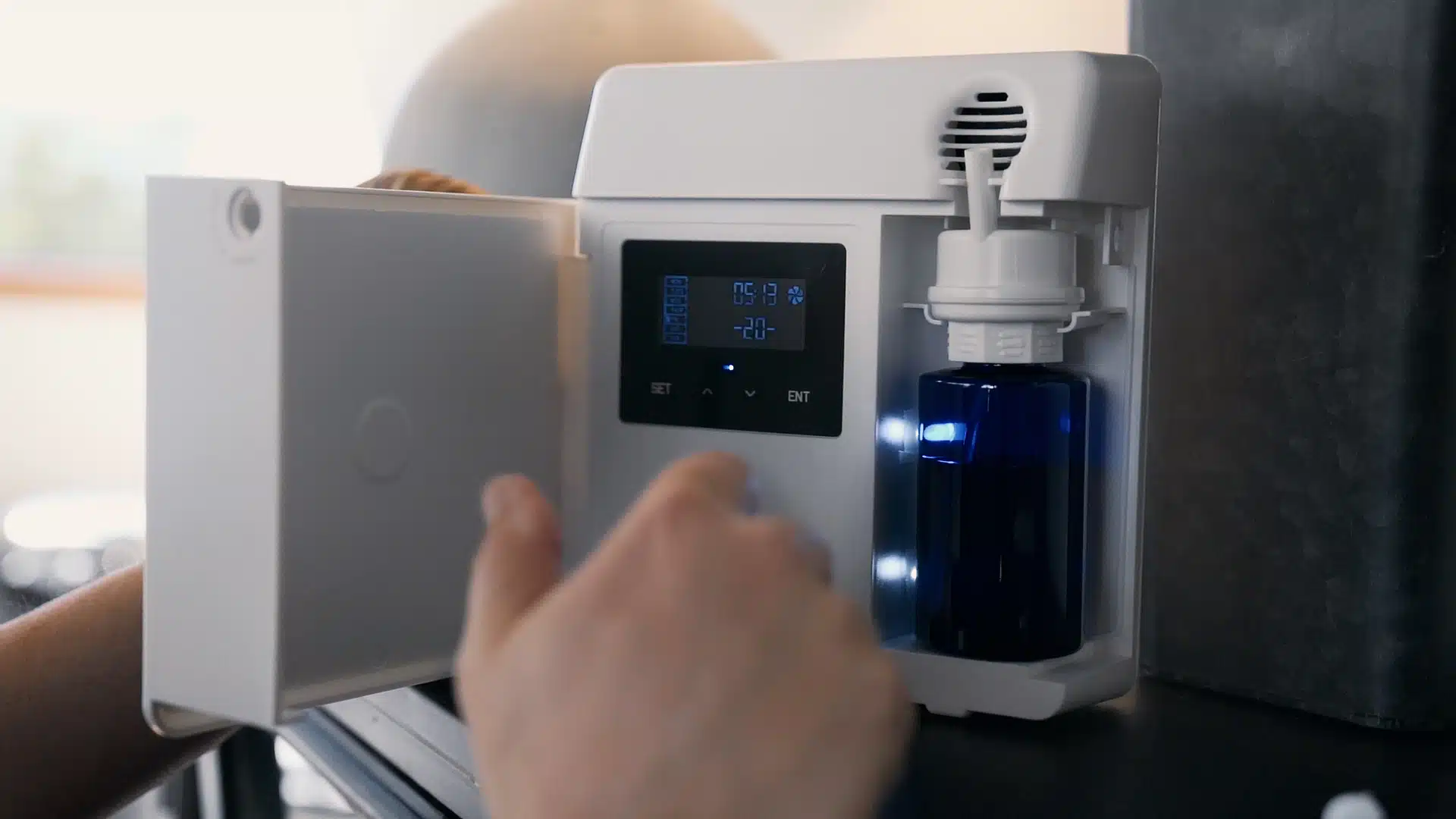
- Installation of state-of-the-art Bluetooth-powered oil diffusing units capable of servicing spaces from 300 square feet to over 50,000 square feet
- Wall-mounted air deodorizing units for targeted placement in high-traffic zones, restrooms, entryways, and common areas
- No equipment purchase required—all diffusion units are furnished and maintained as part of the service
- Technician visits every 28 days to recalibrate, service, and replenish fragrance, ensuring consistent scent intensity between visits
- More than 55 fragrance options, including fresh linen, lavender, citrus blends, warm wood tones, and dozens of additional profiles
We also take a principled approach to odor control: rather than masking unpleasant odors with heavier fragrances, our system eliminates odor-causing molecules at the source before introducing the brand fragrance. This means the scent program delivers a genuinely clean olfactory environment, not a perfumed one.
Real-World Example
A full-service automotive dealership in Tacoma reached out to us after recognizing the showroom’s ambient smell. A combination of industrial cleaning products and residual mechanical odors drifting from the service bay, was creating a sensory disconnect from the premium buying experience they were trying to deliver.
We installed scenting units at the showroom entrance and throughout the sales floor, calibrated to a warm, clean fragrance profile that tested well with the dealership’s primary customer demographic.
Sales staff noted within the first month that customers were spending more time in the showroom and that the number of walk-out-without-engaging interactions had declined. The dealership subsequently extended the program to its service waiting area, where customer satisfaction scores on post-visit surveys improved meaningfully.
With an A+ BBB Rating and more than 3,500 active clients across Seattle, Portland, and Denver, we have the regional reach and the technical depth to serve Washington businesses at any scale, from a single-location boutique to a multi-property management portfolio.
Scent marketing in WA has never been more accessible, and Fikes is the partner that makes it operational rather than aspirational.
The Invisible Competitive Advantage Is Already Available to You
Every day a Washington business operates without a deliberate scent strategy is a day it leaves a powerful branding opportunity unrealized.
Scent branding for businesses works because the science behind it is unambiguous. The direct pathway from olfaction to emotional memory is human neurology. The only question is whether a brand chooses to work with it or ignore it.
National scent programs have made consistent, cross-location olfactory branding achievable for multi-location operators. Professional retail scenting has made the dwell-time and spending benefits of ambient fragrance accessible to independent Washington retailers.
And service partners like Fikes have made the execution of those programs turnkey, requiring no equipment investment, no internal expertise, and no maintenance burden from the business itself.
The competitive advantage scent marketing offers is real, measurable, and already available. Book a free assessment today, learn more about how Fikes can build a scent strategy tailored to your Washington business or property portfolio.