

Scenting boosts workplace productivity and employee mood by stimulating the brain’s limbic system, the region governing emotion, memory, and focus. In Colorado offices, the absence of a deliberate scent strategy means relying on ambient odors that may actively undermine concentration and morale. For businesses, low productivity and poor employee mood translate directly into higher turnover, reduced output, and measurable revenue loss.
The science connecting scent to cognitive and emotional performance is more substantial than most facility managers and HR leaders realize, and it has been building steadily for decades.
The olfactory system is the only sensory pathway with a direct anatomical connection to the limbic system, the brain’s emotional and memory processing center, which means scent bypasses the cognitive filtering that other sensory inputs pass through and produces immediate, largely involuntary physiological responses.
What the research consistently shows is that scent doesn’t simply make a space more pleasant. It actually changes the neurological and hormonal environment in which work happens. Workplace aroma solutions are an evidence-based investment in the conditions that determine how effectively employees think, communicate, and perform across a full working day.
Let’s take a deeper look at how scenting boosts workplace productivity and employee mood.
Table of Contents
Which Aromas Improve Workplace Productivity in Office Environments?
Not all scents produce the same outcomes, and choosing the right aroma for a given workspace requires matching the neurological and emotional effect of a scent to the cognitive demands of the environment.
Peppermint is the most consistently supported aroma for environments requiring focused, sustained cognitive work. Its primary active compound, menthol, produces a mild stimulant effect that increases alertness, reduces mental fatigue, and supports working memory.
Open-plan offices, call centers, and analytical work environments are natural fits for ambient peppermint scenting, particularly during mid-afternoon hours when circadian rhythms create a natural dip in alertness and productivity.
Citrus aromas, including lemon, orange, and grapefruit, are the best-documented choice for environments where mood elevation and stress reduction are primary goals.
For customer-facing environments, reception areas, and collaborative spaces where interpersonal tone matters, citrus scenting produces measurably better results than either unscented environments or generic fragrance applications.
Lavender’s anxiety-reducing properties are among the best-documented in the aromatherapy and environmental psychology literature. For high-pressure office environments, healthcare administrative spaces, or facilities where employee burnout is an identified concern, lavender-based scenting offers a passive, non-pharmacological intervention that reduces the physiological markers of stress without sedating the workforce.
Rosemary has emerged in recent years as a particularly promising option for cognitive performance. Simply being in a room diffused with rosemary aroma was associated with significantly improved memory performance. For environments where information processing and recall are central to the work, rosemary offers a scientifically grounded rationale for ambient scenting.
The following are the primary aroma categories and their best-matched workplace applications:
- Focus and alertness — Peppermint and rosemary are best suited for open-plan offices, analytical work areas, and any environment where sustained cognitive output is the primary demand; both have documented effects on attention, processing speed, and memory retention that make them the strongest candidates for workday ambient scenting
- Mood elevation and stress reduction — Citrus blends and lavender are best suited for reception areas, collaborative spaces, and high-pressure environments where interpersonal tone and emotional regulation are as important as cognitive output; both have documented effects on cortisol levels and self-reported wellbeing that translate into measurable improvements in workplace climate
Choosing the right aroma for each zone of your facility produces the most consistent and meaningful results across the full range of workplace environments.
How Do Scent Diffusers for Businesses Work, and What Separates Professional Systems from Consumer Products?
The gap between a consumer reed diffuser placed on a reception desk and a professionally engineered scent diffusion system is a matter of category.
Understanding how professional scent diffusers for businesses operate helps you make informed decisions about what a serious workplace scenting program actually requires.
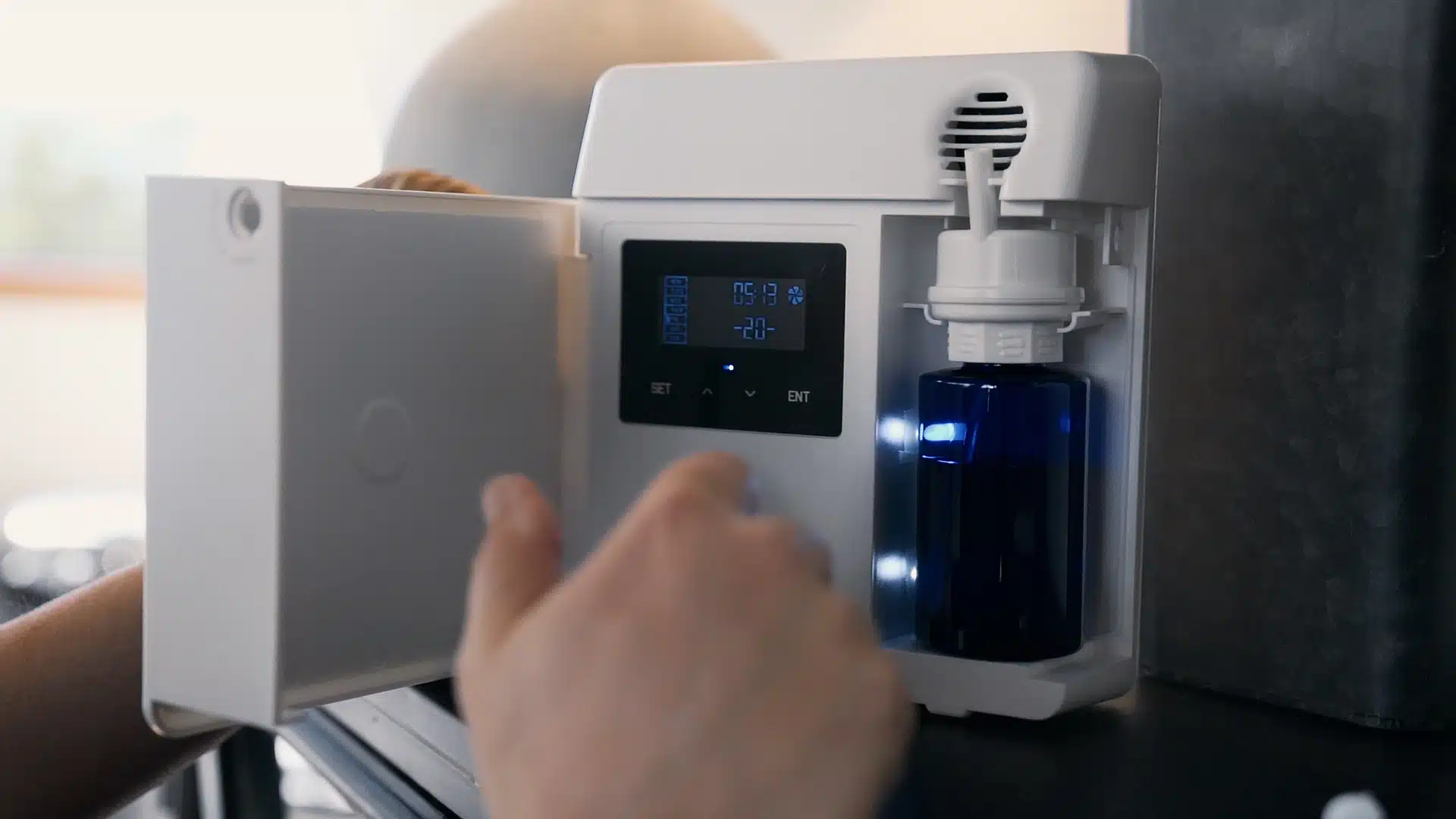
Professional scent diffusion systems operate through cold-air diffusion technology, which atomizes fragrance oil into dry, nano-sized particles that disperse evenly throughout a space without heating or humidifying the air.
Because the particles are microscopic and dry, they remain suspended longer, distribute more uniformly, and leave no residue on surfaces or fabrics. Also, the output volume, diffusion interval, and scent intensity are programmable, allowing a system to run at higher output during peak occupancy hours and reduce during low-traffic periods.
Consumer products, by contrast, rely on passive evaporation, heating elements, or ultrasonic water-based diffusion, all of which produce uneven scent distribution, inconsistent intensity, and in some cases humidity or residue that’s incompatible with commercial environments.
The integration capability of professional systems is the other defining distinction. HVAC-integrated scent delivery allows fragrance to travel through the same air distribution pathways that regulate temperature and ventilation throughout a building, producing the uniform ambient scenting that research studies measure.
For businesses implementing office scenting in CO, or across a national portfolio, professional-grade systems also provide programmable schedules, fragrance cartridge tracking, and maintenance protocols that ensure the system performs as designed across every property in the portfolio.
The investment in professional scent diffusion technology pays dividends not just in scent quality, but in the reliability and scalability that multi-location organizations require.
What Does the Data Show About Scented Versus Unscented Work Environments?
The performance gap between strategically scented and unscented commercial workplaces is measurable across multiple dimensions:
| Performance Metric | Unscented Work Environment | Strategically Scented Work Environment |
| Sustained attention and focus | Baseline | Up to 15–20% improvement with peppermint scenting (Wheeling Jesuit University) |
| Typing/task error rate | Baseline | Up to 54% reduction with lemon scenting (Japanese corporate research) |
| Self-reported stress levels | Baseline | Measurably reduced with lavender and citrus in multiple controlled studies |
| Memory retention and recall | Baseline | Significantly improved with rosemary ambient scenting (Northumbria University) |
| Employee mood and wellbeing ratings | Baseline | Consistently higher in scented environments across workplace satisfaction surveys |
| Perceived workplace quality | Baseline | Higher scores in scented environments, linked to employer brand perception |
| Estimated productivity impact | Baseline | 8–15% improvement cited across multiple corporate field studies |
Ultimately, the cognitive and emotional conditions in which people work are materially affected by ambient scent, and businesses that manage those conditions deliberately outperform those that leave them to chance.

How Does Scent Strategy Scale Across National Corporate Headquarters and Regional Office Portfolios?
Implementing a scenting program in a single office is relatively straightforward. Scaling that program consistently across national corporate headquarters, a network of regional offices, and a mix of owned and leased facilities is another level of operational complexity.
The first challenge is brand consistency. Organizations that have invested in a defined sensory brand need that scent delivered uniformly across every location. A visitor who experiences a company’s headquarters in Denver and then visits the regional office in Portland should encounter the same ambient environment.
Achieving that consistency requires centralized fragrance sourcing, standardized diffusion equipment, and a service provider capable of managing installation, maintenance, and fragrance replenishment across every location in the portfolio.
The second challenge at scale is zoning. A corporate headquarters with a mix of collaborative spaces, private offices, conference rooms, and a client-facing reception area has different scenting needs in each zone.
Designing and maintaining a zoned scenting program across a multi-floor headquarters requires a level of operational sophistication that only professional facility services providers can sustain.
Real-World Example
A national financial services company headquartered in Denver made the decision to implement a signature scent program across its 23 office locations following an internal employee experience audit that identified physical workspace quality as a top-three driver of employee satisfaction scores.
The company chose a citrus-and-cedar blend as its signature office scent, chosen for its documented mood-elevating properties and its alignment with the firm’s brand identity around clarity and confidence.
We installed professional cold-air diffusion systems in all 23 locations over a four-month rollout, integrated with each building’s HVAC distribution system. Fragrance cartridge replenishment and system maintenance were consolidated under a single national service agreement as well.
In the employee satisfaction survey conducted six months post-implementation, overall workspace quality scores increased by 19 points across the portfolio.
Workplace productivity isn’t a function of any single environmental variable, but ambient scenting is one of the few variables that can be managed systematically, at scale, with a documented evidence base and a straightforward service model.
Why Is Fikes the Right Partner for Corporate Scenting Programs in Colorado?
Fikes brings together the fragrance expertise, professional-grade diffusion technology, and national service infrastructure that serious corporate scenting programs require, making us a natural partner for Colorado businesses seeking to improve workplace productivity through a strategically managed scenting program.
Our approach to workplace scenting starts with an environment assessment. We map the functional zones of each space and select scent profiles matched to the documented performance outcomes most relevant to each zone.
This assessment-first model ensures that the scenting program is designed around the actual cognitive and emotional demands of the workplace rather than aesthetic preference alone.
We also deploy professional cold-air diffusion systems and manage all aspects of system installation, programming, fragrance replenishment, and ongoing maintenance under a single service agreement.
For organizations managing national or regional office portfolios, we provide centralized account management and standardized documentation that keeps every location performing to the same standard.
Real-World Example
A Colorado-based healthcare administration company with regional offices in Denver, Colorado Springs, and Fort Collins had been experiencing above-average voluntary turnover among administrative staff.
This was a pattern that exit interviews consistently linked to workplace environment dissatisfaction, including noise, visual monotony, and what multiple departing employees described as an “uninspiring” physical workspace.
They reached out to us to assess and implement a workplace aroma solutions program across all three locations. We recommended a zoned approach: a lemon-verbena blend for reception and common areas to create a welcoming first impression, peppermint diffusion in open-plan work areas to support afternoon focus, and a light rosemary blend in conference rooms to support information retention during training sessions.
In the 12-month period following implementation, voluntary turnover among administrative staff dropped by 23% compared to the prior year. And employee pulse survey scores for “physical workspace quality” increased by 27 points across all three locations. Because of these results, they decided to extend the program to two additional offices.
Ready to Make Your Workplace Environment Work Harder for Your Team?
The connection between ambient scent and workplace productivity is documented, reproducible, and increasingly recognized as a legitimate lever in the design of high-performance work environments.
Businesses that manage their sensory environment deliberately, with the right aromas in the right zones delivered through professional-grade diffusion systems, create measurably better conditions for focus, mood, and sustained output.
The cost of low workplace productivity and disengaged employees is substantial and well-documented. The cost of a professionally managed scenting program is modest by comparison. And the outcomes it delivers compound over time as the workplace environment becomes a consistent contributor to employee experience rather than a passive backdrop.
Connect with us today so that we can design, implement, and manage a scenting program for you that results in a noticeable difference in workplace productivity and employee mood.