
For Washington restaurant owners, professional floor deep cleaning is an absolute necessity to eliminate the hazardous layers of grease, organic matter, and bacteria that daily mopping leaves behind. Neglecting specialized floor restoration directly triggers dangerous slip-and-fall liabilities, foul odors, destructive pest infestations, and critical health department violations that can permanently shut down an establishment.
Maintaining a restaurant in the Pacific Northwest, whether a bustling seafood eatery on the Seattle waterfront or a high-volume diner in Spokane, demands immense attention to detail. Experienced managers are deeply familiar with standard state guidelines: you must wash, rinse, and sanitize every food contact surface continuously.
However, many operators unintentionally treat their commercial floors as an afterthought. Routine daily cleaning with a standard mop and bucket might remove loose, surface-level food particles, but it fundamentally fails to eliminate the invisible, deeply embedded pathogens and heavy fats, oils, and greases (FOG) that settle into porous floor tiles and grout lines over time.
True floor deep cleaning and biological sanitation take safety a step further. Even if your daily back-of-house staff is exceptionally disciplined, a restaurant floor requires monthly professional restoration using specialized high-pressure, thermal equipment.
Investing in commercial floor deep cleaning is a core strategy for operational safety, regulatory compliance, and brand protection.
Let’s look at 4 reasons why professional floor deep cleaning is a must for your restaurant.
1. Eradicating the Toughest Kitchen Hazard: The Organic “Bio-Film”
The single greatest threat hidden on a commercial kitchen floor is bio-film. Bio-film is a microscopic, sticky layer of living bacteria, fats, and organic waste that binds itself to porous surfaces like concrete, quarry tile, and grout channels.
When your team mops at the end of a chaotic shift, a cold mop water bucket quickly becomes saturated with grease. Instead of lifting the grime, the mop spreads a thin layer of dirty, oily water across the floor, redepositing it directly into the porous grout lines.
As this mixture dries, it creates an impenetrable, slick film that acts as an incubator for foul odors and dangerous foodborne pathogens.
Standard floor cleaners can’t break this molecular bond. Eliminating it requires high-temperature, commercial-grade thermal extraction paired with specialized enzymatic solutions that biologically digest the organic matter.
Real-World Example
A popular multi-story seafood restaurant in downtown Seattle noticed that despite their night crew scrubbing the quarry tile kitchen floors diligently every evening, a slick, dark layer was forming in the grout lines.
Worse, a persistent “sour” smell began wafting into the dining room during high-humidity days. The local health inspector noted a dangerous bio-film buildup along the kitchen line, threatening a point deduction on their upcoming inspection.
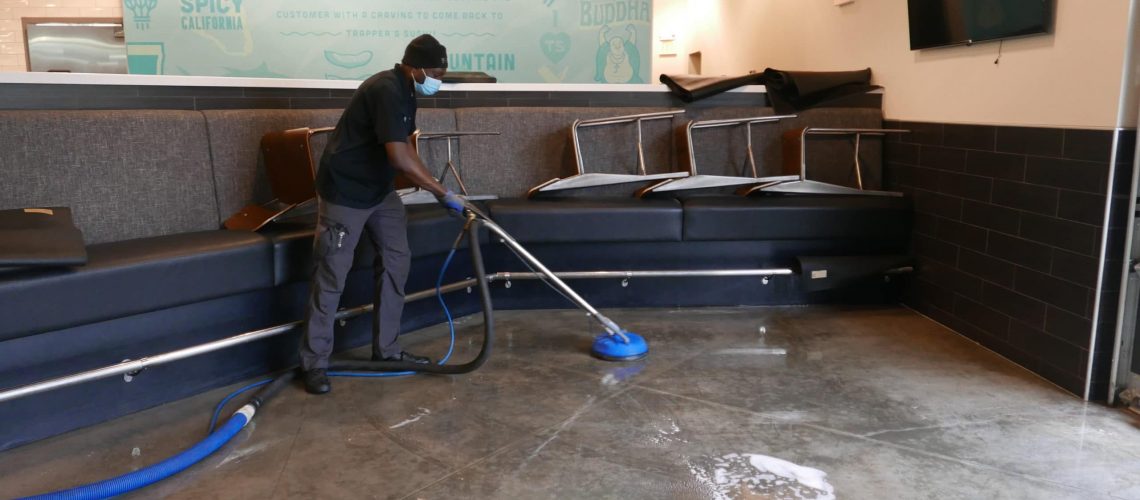
Fikes intervened with our professional floor deep cleaning process. Using 180°F hot water extraction and specialized cylindrical brush machines, we completely broke down and vacuumed away years of impacted fish oils and grease.
The grout lines were restored to their original color, the sour smell vanished instantly, and the restaurant passed its state health audit with a perfect score.
2. Eliminating the Slip-and-Fall Liability Epidemic
Slippery floors are an immediate operational nightmare for any food service business. According to data from the National Floor Safety Institute (NFSI), slip-and-fall incidents represent the primary cause of workers’ compensation claims in the restaurant industry, accounting for over 85% of all employee injuries.
When commercial floors are continually coated in a microscopic layer of kitchen grease, the floor’s dynamic coefficient of friction drops to hazardous levels. Even slip-resistant shoes lose their grip on a grease-slicked tile. When a kitchen line or dishwashing station is hit with a sudden rush of water or ice, the area turns into an ice rink.
Professional deep cleaning completely strips away this oily residue, exposing the natural texture of the tile and restoring its designed slip-resistance.
Floor Type | Primary Vulnerability | Daily Cleaning Failure | Professional Fikes Solution |
Quarry Tile | Highly porous grout lines absorb heavy cooking oils | Mops spread and flatten grease inside the grout channels | 180°F hot water extraction completely lifts and vacuums out oils |
Poured Epoxy | Aggressive textures trap microscopic organic film | Standard mop strings glide over the peaks, missing the valleys | Cylindrical brush machines scour deep into micro-textures |
Polished Concrete | Acidic food spills erode the protective sealant | Harsh retail chemicals dull the finish and trap dirt | Ph-neutral enzymatic deep scrubbing restores surface safety |
Vinyl Composition (VCT) | Scratches and seams accumulate bacteria and grime | Water penetrates open seams, loosening sub-floor adhesives | Meticulous deep extraction safely sanitizes without stripping |
3. Neutralizing the Silent Trigger for Pest Infestations
Pests are highly opportunistic creatures that don’t require a visible pile of garbage to thrive. Insects like fruit flies, drain flies, and German cockroaches, alongside destructive rodents, actively seek out the hidden, damp organic material trapped beneath kitchen line equipment, along floor baseboards, and deep within floor drains.
If your floor grout is degraded or packed with food debris, it serves as an all-inclusive buffet and a perfect nursery for insect larvae. You can hire an exterminator to spray chemicals every week, but if you don’t remove their structural food source, the pests will continuously return.
Sanitation is the absolute foundation of effective pest control.
Effective, specialized floor deep cleaning systematically destroys these hidden breeding zones by targeting:
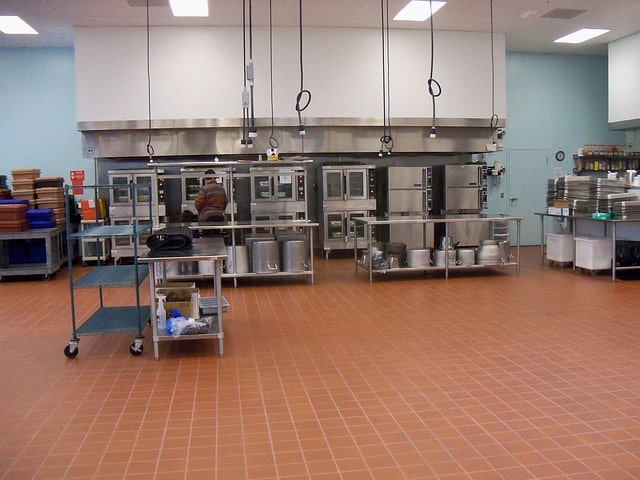
- Behind and Under Heavy Equipment: Completely clearing out the hidden grease traps that form under fryers, ovens, and flat-tops where daily mops can’t physically reach.
- Floor Drain Guts: Flushing out the organic “sludge” inside floor drains where drain flies lay their eggs.
- Wall-to-Floor Junctions: Stripping away the accumulated organic debris that gets packed into the corners and baseboards of the kitchen during nightly sweeping.
- Beneath Rubber Mats: Deep cleaning and degreasing the underside of heavy anti-fatigue floor mats which frequently harbor bacteria.
By eliminating these micro-environments through recurring monthly deep cleans, you safely prevent a minor pest presence from exploding into a full-blown facility infestation.
4. Guaranteeing Regulatory Compliance and Protecting Profitability
Operating a restaurant in Washington means navigating strict local and state health ordinances. Health department officials are expertly trained to look specifically at floor hygiene, drain cleanliness, and the areas beneath your cooking lines.
Discovering heavy grease accumulations, organic slime, or evidence of pest activity can result in immediate point deductions, expensive fines, forced follow-up inspections, or an emergency public closure.
Beyond regulatory compliance, the visual state of your front-of-house floors heavily impacts your revenue. Today’s consumers maintain an incredibly low tolerance for visible dirt. Stained dining room floors, sticky pathways to the restrooms, or grimy entrance carpets signal to a guest that your kitchen hygiene standards must be equally compromised.
Taking total control of your floor cleanliness ensures your physical environment constantly validates your commitment to exceptional hospitality.
Real-World Example
A multi-tenant corporate dining facility in Bellevue was facing continuous friction with a building health inspector over recurring grime rings around their front-of-house service counters and drink stations. The internal janitorial staff was mopping daily, but the high foot traffic was rapidly driving dirt deep into the floor seams.
We established a customized monthly deep cleaning program using automated chemical dispensing systems and precision floor scrubbers. Our non-toxic, food-safe enzymatic treatments dissolved the embedded foot-traffic soils on contact.
The facility transformed its aesthetic presentation, completely eliminated inspector call-outs, and saw an immediate increase in daily customer dwell time and lunchtime sales.
How Does Fikes Approach Professional Floor Deep Cleaning?
Many restaurant owners try to solve floor issues by instructing their staff to perform a “deck brush party” on Sunday nights. Unfortunately, manually scrubbing floors with standard brooms and hoses just pushes the dirty water into floor drains or wall cavities, creating hidden mold hazards.
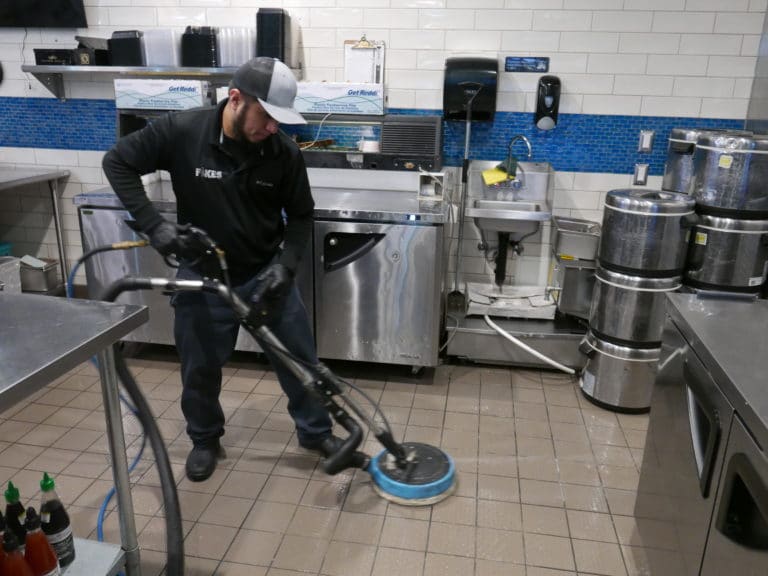
To truly sanitize a commercial floor, you need a specialized mechanical approach. Our commercial floor restoration process includes:
- High-Temperature Deep Scrubbing: Using professional cylindrical brushes that spin at high speeds to aggressively scour both the peaks and valleys of textured floors.
- Full Fluid Extraction: Rather than pushing dirty water around, our advanced machines immediately vacuum up the emulsified grease and wastewater into a sealed recovery tank, leaving floors bone-dry and completely residue-free.
- Targeted Industrial Chemistry: Deploying premium, non-toxic degreasers and biological floor treatments that safely eat away at stubborn animal fats and vegetable oils without damaging your underlying infrastructure.
How Can You Keep Your Restaurant Floors Clean Long-Term?
Your floors are the physical foundation of your entire restaurant operation. Don’t allow hidden grease layers, safety liabilities, or poor daily cleaning habits to jeopardize your team’s safety, your positive online reviews, or your local health department standing.
By investing in a professional floor deep cleaning program with Fikes, you take a proactive, defensive stance that preserves your infrastructure, lowers your operational stress, and keeps your restaurant running beautifully from the front door to the back line.
Get in touch with us today to schedule your comprehensive restaurant floor audit and deep cleaning service. Let our trained teams manage the dirty details so you can focus on delivering an unforgettable dining experience.